© 2005 by Lars Krutak
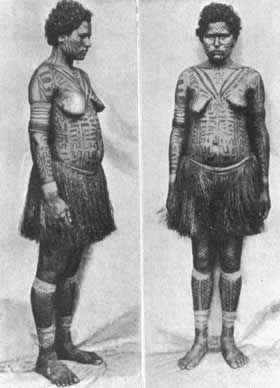
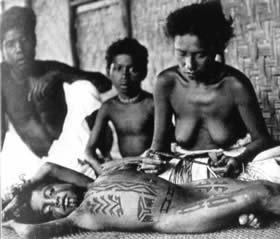
As far back as the old men and women can remember, tattooing has been a tribal custom of the coastal peoples of Papua New Guinea. Among the Motu, Waima, Aroma, Hula, Mekeo, Mailu and other related southwestern groups, women were heavily tattooed from head to toe, while men displayed chest markings related to their exploits in the headhunt. By World War II, however, tattooing traditions largely disappeared in these areas and today only the Maisin and a few neighboring peoples of Collingwood Bay in southeastern Papua remain as the last coastal people to continue tattooing itself.
Tattoos were generally inked upon women in a fixed order among all coastal Papuans. First, girls between five and seven years of age were tattooed on the backs of hands to the elbows and from the elbows to the shoulders. Girls between seven and eight were tattooed on the face and lower abdomen, the vulva and up to the navel, then the waist down to the knees and the outside of the thighs. At ten, the armpits and areas extending to the nipples were tattooed with the throat done shortly thereafter. When puberty approached, the back from the shoulders down, then the buttocks, back of the thighs and legs were marked. When ready for marriage, V-shaped designs from the neck down to the navel were tattooed. Sometimes, special tattoos could be added if the father, brother, or close relative of the girl killed another man, or if they showed prowess in fishing or trading expeditions. All of these markings were ritualistic, and in some cases erotic. If a girl did not have them, she was not acceptable for marriage.
Read on here
Showing posts with label Papua New Guinea. Show all posts
Saturday, January 21, 2012
Thursday, November 10, 2011
News Bits: PNG-SABL leases flawed, Google to end support for BlackBerry Gmail...
PNG news via Post Courier Online
POMIO women expressed shock before the SABL inquiry in Kokopo yesterday when told they were signatories to the lease-lease back agreement.
They were in even more shock to learn that some of the signatories were their own children who were so young they would not even hold up an ink pen.
SABL Commission of Inquiry commissioner Alois Jerewai expressed concern at the findings which is hearing into four SABL leases in Pomio which involve Gilford Limited, a subsidiary of Rimbunan Hijau, the owners of The National newspaper.
Mr Jerewai said it appeared the documents involved in securing the SABLs were flawed.
He questioned the Land Investigation Report used to supplement the SABL leases.
Mr Jerewai heard from Pomio women leaders Claudia Koisilele and Ludwina Kora that they had never signed any agreement giving their land away. (read on here)
Google to end support for BlackBerry Gmail app this month (SOURCE 1) (SOURCE 2)
Google has already made quite a few significant cuts to services it's deemed outside of its focus in the past few months, and it's now made another that surely won't please a particular subset of its users. It's announced that it will end support of the Gmail app for BlackBerry phones on November 22nd. Those that have the app installed will be able to continue using it indefinitely, but it will no longer be supported by Google or available for download after the cut-off date (so you might want to grab it now if you don't already have it). In its place, Google is directing BlackBerry users to the mobile web app accessible through the browser, and it notes that it will "continue investing in this area."
Several thousand' more apps set to hit Kindle Fire next week (SOURCE)
Poised to give the Ipad 2 a run for its money the Kindle Fire will arrive with several thousand android apps when released later this month-including Twitter, Facebook and Netflix.
Read on for their Press Release
Labels:
News Bits,
Papua New Guinea,
technology
Saturday, May 21, 2011
Newsbits: J.Cole album, PomCRS Morning Tea...
J. Cole promises no more hold ups
J. Cole is finally gearing up for the release of his debut album, promising fans that there will be "no more hold up." Speaking at a press conference for the 2011 BET Awards, Cole said he was preparing to get deep into the promotional cycle with the release of an as-yet-untitled new single.
"Now it's time," he said. "I always had the material for the album. The hold-up was always picking the right single. I think we knew that there was so much on the line and the potential that I had, so we were kind of hesitant.... [Now,] there's no more hold up."
Labels:
cancer,
entertainment,
events,
J.Cole,
music,
news,
Papua New Guinea,
Port Moresby,
sony playstation
Thursday, April 21, 2011
Timothy Allen's Human Planet Photos
Waiting for my latte this morning, I came across this image on the front cover of this month's issue of Redbull Magazine. Several google searches later and I found that the images were taken as part of a BBC documentary titled Human Planet and features the photos of Timothy Allen. Allen not to be confused with American comedian/actor of the same name, is best "known for his work with indigenous peoples and isolated communities around the world."
In 2008, the BBC commissioned Allen to shadow its film crews during the shooting of the documentary project Human Planet. This was the first time that the BBC had employed a dedicated stills photographer on a landmark series. He spent over a year and a half travelling with 4 teams, covering stories of human endeavour in over forty countries around the world. The resulting imagery was published in a best-selling BBC book, formed an exhibition and was used in the program's worldwide branding and publicity. (source). The documentary is currently being screened at 8pm on the Discovery Channel on Sunday nights (see here for listings)
His top 40 round up features a lovely picture of of PNG's most recognisable tribal groups- the huli wigmen, in this case the little boy in the picture stole the show
Visit the Human Planet website to read his article Birds of Feather which features images from the Mount Hagen Show or see here for more images featuring Papua New Guinea.
Be sure to check out his personal site http://humanplanet.com/timothyallen/ or visit the Human Planet Blog to see all the images and stories behind the images.
In 2008, the BBC commissioned Allen to shadow its film crews during the shooting of the documentary project Human Planet. This was the first time that the BBC had employed a dedicated stills photographer on a landmark series. He spent over a year and a half travelling with 4 teams, covering stories of human endeavour in over forty countries around the world. The resulting imagery was published in a best-selling BBC book, formed an exhibition and was used in the program's worldwide branding and publicity. (source). The documentary is currently being screened at 8pm on the Discovery Channel on Sunday nights (see here for listings)
His top 40 round up features a lovely picture of of PNG's most recognisable tribal groups- the huli wigmen, in this case the little boy in the picture stole the show
![]() |
| SOURCE |
Visit the Human Planet website to read his article Birds of Feather which features images from the Mount Hagen Show or see here for more images featuring Papua New Guinea.
Be sure to check out his personal site http://humanplanet.com/timothyallen/ or visit the Human Planet Blog to see all the images and stories behind the images.
Labels:
Papua New Guinea,
photography,
Timothy Allen
Sunday, February 20, 2011
Animal Audio and Naka Blood Collaborate
I'm a couple of weeks late with this post but better late-ish than never. Both groups are based in Port Moresby, Papua New Guinea and they're styles are a blend of rap, reggae and RnB.
You can find links to their resepective sites here:
Naka Blood on Reverbnation and facebook
Animal Audio on facebook
and download Animal Audio's Come Retire With Me here
Labels:
Animal Audio,
Naka Blood,
Papua New Guinea,
PNG music
"sky's the limit" PNG art at 4 mile in The National
Labels:
Art,
Papua New Guinea
Thursday, December 16, 2010
Thursday, December 2, 2010
FASHION AND BILUM, FROM TRADITION TO MODERNITY, FROM INDIVIDUAL CREATION TO COLLECTIVE ACHIEVEMENT

Essay by Nicolas GarnierRead on here.
Centre de Recherche et de Documentation sur l’Océanie
University of Papua New Guinea
Alliance Française de Port Moresby
In Papua New Guinea (PNG), string bags, or bilum in Tok Pisin (a widely spoken Creole), are commonly used by men and women to transport commodities. Traditionally, men carried small tools, tobacco leaves, and small items in their bags. In the Highland region around Goroka, larger bilums served as quivers for arrows. Today, men’s bilums carry modern commodities reflective of Papua New Guinea’s rapidly modernizing society. Traditionally, men carried one bilum, while women carried several. Large bilums were used to transport crops from gardens to family dwellings, or to carry produce for sale or exchange at local markets. Smaller ones contained tools or objects necessary for daily activities. In some regions of the country, bilums cradled babies. Like men, women have adapted bilums to the necessities of urban life: looping techniques have become smaller and tighter so that bilums have become solid and opaque; carrying straps have become shorter so that “urban bilums” resemble European women’s shoulder bags.
SOURCE
Labels:
bilums,
Papua New Guinea
Tuesday, November 30, 2010
Yumi PNG perform at North Shore Pasifika 2010
This past Saturday (27/1110), a young group of Papua New Guineans performed at Auckland's North Shore Pasifika festival in New Zealand.
Comprising of members of Manus, Oro, Kerema, Milne Bay, Western Highland and Engan heritage, Yumi PNG was formed so that the youth based in Auckland's North Shore could firstly get in touch with their roots through traditional songs and dances and secondly to create a support system for themselves as a number of them have recently moved to New Zealand and transition into a new way of life and culture can be difficult.
Headed by their youth leaders Michaelyn Pokarop, Kimberly Mills and Udu Mea, the group have been practising since September for the event and on Saturday performed a dance from Milne Bay and a dance from Manus.This was the group's first official performance and the group intend to keep learning new songs and dances and hope to be able to continue performing in and around Auckland to showcase Papua New Guinea and its diversity to a country that still knows little about their island neighbour.
Saturday, October 30, 2010
Quick links: Jeffry Feeger Interview, Its Our Game
Jeffry Feeger Interview on Radio Australia
Just finished listening to his interview with ABC Radio Australia whilst in Shanghai after he won the Shanghai Art Battle at the World Expo. Jeffry really is an inspiration to PNG artists. He's really proving that if you really have the talent and the determination to do something outside of the norm of getting a 9-5 job, you can do it.
Click here to listen
Its Our Game
Albert Veratau and Garry Juffa represent two clashing ideologies. Veratauism consist of building the code by forging strong relations with a major partner who will provide financial and technical support. It reached the echelons of our relations with Australia when former PM Rudd pulled strings to get the ball rolling on the NRL contemplating a 2015 entrant for one of our teams. Even at the operational level we saw a mass injection of technical assistance. Whole bunch of blokes flooded our shores bringing goodies. The Pacific Cup saw a full team of dimdims in everything. From setting up the PA system, touch judges, promotion and marketing consultants and even water boys. Why even the great Adrian Lam looked far and wide in the great southland for kumuls. Recruiting them from the North all the way to the south and boy they put on a show. Trashing every pacific country that came our way. It was something and Veratauism had prevail in bringing the code much needed attention.
Read the full post over at the Masalai Blog for the rest
Labels:
Art,
Jeffry Feeger,
Kumuls,
masalai blog,
Papua New Guinea,
rugby league
Saturday, July 10, 2010
Ngaire- Glorious
This is a cute video and she's a great singer too!
Labels:
good music,
ngaire,
Papua New Guinea
More than meets the eye
Being out of the country for a long time it is easy to be out of touch with the realities of home. Whilst I used to pride myself on being "in the know" of the real issues facing my fellow countryman and where to go to find out what's happening in the country in the last 2 years I've admittedly lost touch. I hope to be able to at least be able to have some awareness of the issues affecting PNG society and at least be able to contribute something and give back.
For a couple of months now I have been receiving a Nasfund email. I'm not sure how I ended up on their mailing list (and I'm a little worried about how I did get on the list) but from the newsletters I have been able to see numerous NGOs and charity organisations that in an ideal world I would love to be active in or contribute in some way-when I say ideal I mean if I had either time or funds to contribute-but I digress.
Given that internet access is still very limited by international standards I was stupidly suprised (I shouldn't have been so ignorant)that a lot of these organisations do have websites-no doubt necessary as a lot of their target audiences will either be in the developed world or the minority in the country who have access to the internet either at work or home.
So here it is, a few PNG/PNG related sites that I didn't know existed:

Another interesting thing I noted in the June 2010 newsletter was the PRIDE OF PNG AWARDS FOR WOMEN 2010. I hope that lots of nominations were made and that women get some shine for their efforts and contributions!
Pride of PNG Awards for Women 2010: “Empowering Women”
Pride of PNG awards for women is a community service initiative by City Pharmacy in recognizing and rewarding simple Papua New Guinean women. This awards program is for the women who are not well-known, they are the simple, ordinary women but contribute immensely to the development of the country through their involvement in various sectors in their community. Women who are volunteers, church leaders, and advocates in major campaigns such as Violence against women, HIV/Aids and gender based issues. Many are single mothers or are in the public servants as teachers or nurses going out of their way to making life better for others. These are everyday Papua New Guinean women who at the end of the day, work for one purpose and that is to make it better for others.
Under the Patronage of His Excellency Grand Chief Sir Paulias Matane, City Pharmacy initiated these awards so there will be an avenue where these women can now have their stories be told, for people to nominate women in this country who they feel deserve the recognition for the work they do.
With the support of Post Courier, the nations leading daily paper, City Pharmacy Limited is the first organization to offer this sort of awarding system to celebrate the lives of many unsung heroes of this nation. It is with pride that there is now a platform of encouragement and a system of empowerment for women as we progress into the future.
For the past 3 years, 6 medals have been awarded annually for the categories of Bravery and Courage, Community Spirit, Environment, Education/Role Model, Young PNG and the Disability.
City Pharmacy has dedicating a decade to these awards and anticipates a clear vision of supporting over 60 women every year. Whether as community workers or as honest long serving public servants in various departments such as health and education, those that volunteer in NGO’s or work with churches. And for the aspiring young Papua New Guineans who prove to promising hope for a better future of this country.
There are 6 categories, includes a replacement category in 2010.
1. Bravery and Courage
4. Environment and
2. Community Spirit
5. Young PNG
3. Care and Compassion (replaces Disability)
6. Education / Role Model
Please nominate an unsung hero today and make them proud that what they are doing is important. The recognition they get breathes new strength and empowerment. It breathes new life.
Nominations forms and brochures are free at all City Pharmacy, Stop n Shop and Hardware Haus branches nationwide and on page 5 of your daily Post Courier or email prideofpng@cpl.com.pg
Please take time to nominate an unsung hero today. Nominations close on July 16, 2010
For a couple of months now I have been receiving a Nasfund email. I'm not sure how I ended up on their mailing list (and I'm a little worried about how I did get on the list) but from the newsletters I have been able to see numerous NGOs and charity organisations that in an ideal world I would love to be active in or contribute in some way-when I say ideal I mean if I had either time or funds to contribute-but I digress.
Given that internet access is still very limited by international standards I was stupidly suprised (I shouldn't have been so ignorant)that a lot of these organisations do have websites-no doubt necessary as a lot of their target audiences will either be in the developed world or the minority in the country who have access to the internet either at work or home.
So here it is, a few PNG/PNG related sites that I didn't know existed:
Another interesting thing I noted in the June 2010 newsletter was the PRIDE OF PNG AWARDS FOR WOMEN 2010. I hope that lots of nominations were made and that women get some shine for their efforts and contributions!
Pride of PNG Awards for Women 2010: “Empowering Women”
Pride of PNG awards for women is a community service initiative by City Pharmacy in recognizing and rewarding simple Papua New Guinean women. This awards program is for the women who are not well-known, they are the simple, ordinary women but contribute immensely to the development of the country through their involvement in various sectors in their community. Women who are volunteers, church leaders, and advocates in major campaigns such as Violence against women, HIV/Aids and gender based issues. Many are single mothers or are in the public servants as teachers or nurses going out of their way to making life better for others. These are everyday Papua New Guinean women who at the end of the day, work for one purpose and that is to make it better for others.
Under the Patronage of His Excellency Grand Chief Sir Paulias Matane, City Pharmacy initiated these awards so there will be an avenue where these women can now have their stories be told, for people to nominate women in this country who they feel deserve the recognition for the work they do.
With the support of Post Courier, the nations leading daily paper, City Pharmacy Limited is the first organization to offer this sort of awarding system to celebrate the lives of many unsung heroes of this nation. It is with pride that there is now a platform of encouragement and a system of empowerment for women as we progress into the future.
For the past 3 years, 6 medals have been awarded annually for the categories of Bravery and Courage, Community Spirit, Environment, Education/Role Model, Young PNG and the Disability.
City Pharmacy has dedicating a decade to these awards and anticipates a clear vision of supporting over 60 women every year. Whether as community workers or as honest long serving public servants in various departments such as health and education, those that volunteer in NGO’s or work with churches. And for the aspiring young Papua New Guineans who prove to promising hope for a better future of this country.
There are 6 categories, includes a replacement category in 2010.
1. Bravery and Courage
4. Environment and
2. Community Spirit
5. Young PNG
3. Care and Compassion (replaces Disability)
6. Education / Role Model
Please nominate an unsung hero today and make them proud that what they are doing is important. The recognition they get breathes new strength and empowerment. It breathes new life.
Nominations forms and brochures are free at all City Pharmacy, Stop n Shop and Hardware Haus branches nationwide and on page 5 of your daily Post Courier or email prideofpng@cpl.com.pg
Please take time to nominate an unsung hero today. Nominations close on July 16, 2010
Labels:
ignorance,
Papua New Guinea,
women
Wednesday, March 24, 2010
Te Papa pays record for painting

Te Papa has paid what is believed to be a record $18,000 for a striking piece of modern Papua New Guinean art by an artist who says New Zealand defined him.
READ ON HERE
Labels:
Art,
Daniel Waswas,
NZ,
Papua New Guinea
Sunday, March 14, 2010
Sunameke @ Opening Night Pasifika 2010
My sisters and I part Mekeo and Manus. We were a little bit nervous that our cousins asked us to perform with them at the opening night at this year's Pasifika festival.
We (my sister's and I) have never taken part in a mekeo dance and our untrained and uncordinated sways left us feeling quite awkard and nervous that we wouldnt be able to pull off a decent performance. Whilst our sways (I dont think that's event the correct term to us) were nearly right we were still very nervous about the dance. But once we got on stage we danced heads held high and proud at the fact that we were giving the audience a very different view of the pacific and representing PNG which has never had any proper reprsentation at Pasifika.
We left the stage to a very stunned audience who were wondering where exactly we were from and what exactly we had performed. Most importantly, my sisters and I left the stage feeling extremely proud and grateful that we had finally gotten the opportunity to get in touch with our roots.
Big thank you to my cousins Julia and Yola as well as Kat and Sam aka Sunameke for giving us the chance to dance with them as well for the unforgettable experience.


Labels:
Mekeo,
Papua New Guinea,
Pasifika 2010,
Sunameke
Wednesday, March 10, 2010
PNG ART-Daniel Waswas:Look Within II
Congratulations to Daniel Waswas of Papua New Guinea whose magnificent work Look Within II has been purchased by Te Papa Tongarewa Museum. It was one of three Waswas works in the recent Ancestors of the Realm Exhibition at the Kaohshiung Museum in Taiwan. Aucklanders can view the other 2 pieces and have coffee with Daniel this Monday at 11am at okaioceanikart@Reef Gallery 69 Beach Rd.
Daniel Waswas
Look Within II
Acrylic on canvas
2000 x 1500mm
SOURCE
okaioceanikart
Labels:
Art,
Daniel Waswas,
Papua New Guinea
Wednesday, February 24, 2010
Saturday, October 3, 2009
PNG to host 2015 South Pacific Games
This past week, Papua New Guinea was successfull in its bid to host the 2015 South Pacific Games. We did a great job of hosting back in 1991 but I'm sure the question on a lot of people's minds is WHERE the US$100 million that was pledged for the games will come from?
Labels:
Papua New Guinea,
South Pacific Games
Monday, September 7, 2009
PNG centre stage at Westfield Style Pasifika


A little known PNG first timer took out this years Westfield Style Pasifika's Body Art Section.
William Jakk from Milne Bay but based in Auckland entered this year's body art section and won. His design titled Snake People and modelled by Harry Hillary Jenkins was a stand out amongst the six other finalists.
Using clay and soil mixed with body paints William akso added PNG masks into the mix to create his winning design.
It was great to see PNG being represented on Friday night and to have William win was truely an added bonus. All the Papua New Guineans there that night were especially proud!
Labels:
Art,
auckland,
fashion,
Papua New Guinea
Wednesday, August 19, 2009
Parents attitude towards girls education
This article was spotted on the Post Courier Online. While it highlighted several issues in contemporary PNG society I think it should also be noted that there are also large numbers of strong and intelligent women in the country who are doing very well for themselves in their careers and also in doing what they can to provide and look after their families. The New Age Woman also does well in highlighting the success of PNG women.
By PES WILSON
Culturally, some societies perceive women as a utility asset to undertake all household chores ...
EDUCATION is considered a tribal investment in some parts of Papua New Guinea. The prime objective of an investment is to make a profit. If the investment is not viable in terms of profitability there is no guarantee for its continuity.
The principle of “invest less and gain more” is applied when choosing who goes to school, and in the process, a lot of girls miss out as they are considered to be unprofitable. They are valued at the instant market price. Many factors and cultural actors play certain decisive roles in denying girls’ the right to education.
Lack of role models
One reason why girls miss out on education is because there are not many female role models. Professional jobs such as doctors, teachers and so on are all male-occupied that people loose interest in the capacity of women getting a job. This leads to the wrong investment picture that females reflect.
In a patrilineal society, education has been meddled with the existing culture in undermining the realisation of females’ potentials. Most decisions in the cultural arena regarding social, religious and political matters are solely left to the men to make. A woman’s worth is measured by the number of pigs she can raise and the number of children she bears. Therefore, females are barred from going to schools.
This creates inequality in the choices made by the parents as to who should go to school and why. This is against the Universal Basic Education principle which proclaims ‘education for all’ where every person regardless of culture, sex, religion and race has rights to an education.
High bride price and low intellectual capabilities
Girls are a source of instant wealth, therefore, are retained at home for bride price. Research confirms that parents value most of their young girls like gold, coffee and other commodities to be traded at the immediate market value. They are only few and scarce that their value has soared recently. This is even worse around Ialibu area and some parts of Central Province. Some young girls can cost around K20 000.
Women are used as the medium to achieve human prosperity. They facilitate for the channelling of wealth like pigs, shell money, pearls, food, modern money and other goods from one person or tribe to another. Poor families with many girls have the fate of becoming rich one day from the wealth that the girl would acquire through bride price payment. Thus, girls are reserved for marriage by their siblings.
Some parents question the females’ intellectual capabilities and say they will not perform as well as the male students. They say that males are naturally intelligent and can solicit solutions for academic problems quite easily than females. In the cultural arena, opinions and advice from women are not entertained by men in all forms of decision making. All decisions are based entirely on the men’s instincts as to what they think is right. Women are merely seen as trailers or followers.
Investment in girls’ education lost to husbands at marriage
Some parents say that their investment in their girls’ education will be lost to the girl’s husband at marriage. In the parochial cultural system, most parents’ fear that their resources spent on their daughter’s education will be shifted to the husband at marriage as she will be subject to the husband. The woman is equivalent to any asset the man may have, with no human value. Her value and worth is measured by the number of pigs she rears and the number of children she bears. There is no guarantee for her to go back and share the benefits of her education with her parents. Therefore, parents restrict their girls from attending school as their investment will be wasted. Moreover, parents do all the arrangements for their daughters’ marriage and this could happen while the girl is still at school. They can withdraw their daughter from school at any time, sometimes, without her knowledge. Whether or not the girl is doing well academically, she has to comply as it is embedded in the cultural and tribal jurisdictions and she will be coerced to marry.
Girls, as pillars of local economy
Girls are the backbone of the local economy. Therefore, parents retain them at home. Culturally, some societies perceive women as a utility asset to undertake all household chores. They fear that educated women will not listen to the dictates of men. They view education as an instrument that alienates women from their environment and makes them less submissive to the dictates of men.
The continuation of men holding high positions in the traditional hierarchy is fading away as monetary value and those who work for money become more important because they gain respect in the society, irrespective of whether they are men or women. Men’s continuation of dominance in the society is facing a new threat by educated girls. Girls must be stopped from going to school and the existing cultural phenomena are potentially capable of barring girls from going to schools.
Distance and tribal fights
Parents fear for their girls’ safety and stop them from walking long distances to schools when there is a tribal fight. Most tribal fights are caused by land disputes, rape and payback killings and are fought on all frontiers without any truce to limit and control the scope of fighting. In such conditions, girls become vulnerable to being abused and injured when walking long distances to schools as some of the schools are situated in enemy territory. Walking through valleys, climbing gorges and mountains, crossing fast flowing rivers or walking along bush tracks to reach their schools places them at the mercy of enemy clans. The only alternative is to leave school because their continued safety is not guaranteed.
There is dire need for awareness to be carried out on the importance of equality and participation in education. Various stakeholders must fund a continuous intensive awareness program until people are fully aware on what to do to eradicate under-representation of girls in schools. Moreover, the educated elites must inform their parents not to stop girls from going to school. Parents must be told that girls are not commodities to be traded as currently, this is what is happening. Faith-based organisations should be supported to carry out awareness through their services and activities so that their congregations are informed of the disadvantages of denying girls their rights to education.
Finally, it is everyone’s responsibility to carry out awareness by asking, pleading and informing parents to send their girls to school.
– Pes Wilson is a cadet researcher in the education studies division at the National Research Institute
SOURCE: Post Courier Friday 31/07/09
Labels:
Papua New Guinea,
society,
women
Monday, July 20, 2009
Ronin Films

Ronin films is a Canberra based film distribution company. My partner after one of his long sessions trawling the net for all things PNG asked me to do a post on them after he found that they'd had a sprisingly long list of PNG films in their distiribution list.
Ronin films have been around for over thirty years and they primarily distribute independent films into the "non-theatrical" section of the film industry.The films they distibute on are hand picked by their founder Andrew Pike-"The criteria for selection are intrinsic quality and educational interest".
At present they have a list of about 17 PNG films the oldest dating back to 1976 (GOGODALA: A Cultural Revival) and the most recent films being Papa Bilong Chimbu (2007). For a full list of the PNG films on their distribution list, visit this link.
Labels:
film,
Papua New Guinea,
Ronin Films
Subscribe to:
Posts (Atom)